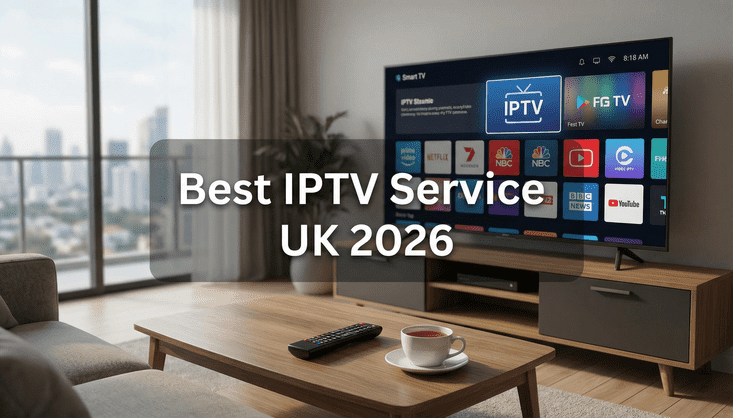
Right, so you've heard about IPTV. Maybe a mate mentioned it down the pub, maybe you stumbled across it while googling why your Sky bill went up again, or maybe you're just tired of paying through the nose for channels you never actually watch. Whatever brought you here, you're in the right place.
The best IPTV service UK is genuinely one of those things where the market has exploded so fast that most people don't even know where to start. Two years ago, options were limited. Now there are dozens of services competing for your money, and the quality gap between a good one and a bad one is enormous. So let's cut through the noise.
I've tested more of these services than I care to admit. Some were brilliant. Some were absolute disasters. And I've learned that finding a good UK IPTV provider is less about luck and more about knowing exactly what to look for before you hand over your card details.
What actually makes a great IPTV service in the UK
Stability first. Always stability first. I cannot stress this enough. You can have the most impressive channel list in the world, crystal clear 4K streams on paper, a slick app that looks gorgeous. None of that matters if your stream freezes during the 89th minute of a Premier League match. And trust me, it will freeze at exactly that moment. Murphy's law is especially cruel when it comes to IPTV.
A genuinely good IPTV subscription UK handles peak load without breaking a sweat. Saturday afternoons, Champions League nights, major boxing events. These are the stress tests that separate the real services from the ones that oversell their server capacity and hope nobody notices.
After stability, channel selection matters. Not just the number of channels, which is mostly a marketing number, but the actual channels you care about. For most UK users that means the main terrestrial channels, the sports channels, and ideally a solid on-demand library. Whether that's Sky Sports, BT Sport, Premier League coverage, or a mix of everything depends on you.
The sports question everyone asks
Can you watch Premier League on IPTV? Yes. Can you watch it reliably, in good quality, without the stream dying when your team finally scores? That depends entirely on the provider.
The best IPTV UK services have dedicated sports streams that are separate from the general channel pool. This matters more than most people realise. When 10,000 people are all trying to watch the same match at the same time, a provider with proper infrastructure handles it. One without doesn't. It's that simple.
Same goes for Champions League, Six Nations, Formula 1, cricket. These are high-traffic events and they're the real test of whether a service is worth your money long term. A decent trial period will usually coincide with at least one major sporting event, so pay attention to how the service performs under that pressure.
Devices and how it all works
One of the things I genuinely love about a good IPTV service is how flexible it is. You're not tied to a specific box or a specific room. Most decent services work on Firestick, Android boxes, Smart TVs, phones, tablets, laptops, basically anything with an internet connection and a screen.
The setup is usually straightforward. You get your login credentials after subscribing, you download the app your provider recommends, usually something like IPTV Smarters or TiviMate, and you're up and running in about ten minutes. I've helped my dad set it up twice now. He's not exactly a tech wizard and he managed fine both times.
For Firestick users specifically, the process is a bit different because Amazon doesn't allow certain apps through the official store. You'll need to sideload the app, which sounds complicated but really just means downloading it from a different source. There are solid guides online for this, and most good providers will walk you through it if you ask their support team.
How much should you actually be paying
Here's where I'll be completely straight with you. The pricing for IPTV in the UK ranges from suspiciously cheap to genuinely reasonable, and the correlation between price and quality is real but not perfect.
Services charging three or four pounds a month for unlimited everything are almost always cutting corners somewhere. Either on server quality, on the number of channels that actually work consistently, or on customer support that disappears when you have a problem. You're not getting a bargain, you're getting what you pay for.
On the other hand, you absolutely don't need to pay Sky prices. A solid UK IPTV provider with good infrastructure, a proper channel selection including sports, and actual customer support typically sits somewhere between ten and twenty pounds a month. If you go for an annual plan, the monthly cost drops considerably. And when you compare that to what Sky or Virgin charge for a fraction of the content, it starts looking very attractive.
At LuxStreams the pricing is clear, the trial lets you actually test the service before committing, and you're not locked into anything long term until you're sure it works for you. That's how a confident service operates.
The legal side, briefly
I know this is the bit everyone skips but stay with me for two minutes because it actually matters.
IPTV as a technology is completely legal. Streaming video over the internet is what every major platform does. The question is whether the provider has licensed the content they're delivering. A legitimate IPTV service pays for the rights to stream the channels in its lineup. An illegitimate one doesn't.
As a consumer in the UK, your safest position is choosing a provider that operates transparently, has proper contact information, takes legitimate payment methods, and can actually explain what you're getting for your money. If a service looks sketchy, operates anonymously, and promises thousands of channels for next to nothing, that's a signal worth paying attention to.
This isn't about being paranoid. It's just about making a sensible choice when better options exist.
Getting the best picture quality
Your internet connection matters here more than anything else. For standard HD streams you need a stable connection of around 10 Mbps. For 4K you want 25 Mbps or more. And I do mean stable, not just fast. A connection that averages 50 Mbps but drops and spikes is worse for streaming than a solid 20 Mbps line.
If you're on Wi-Fi and getting buffering issues, try a wired connection before blaming the IPTV service. Ethernet makes a noticeable difference, especially for live sports where there's no buffer to fall back on. It's the kind of small change that completely transforms the experience.
Most good providers offer multiple stream quality options. If you're on a slower connection or watching on a phone, dropping from 4K to HD will give you a much smoother experience. There's no shame in that. A smooth HD stream beats a stuttering 4K one every single time.
Customer support, which matters more than you think
This is the thing most people don't think about until something goes wrong. And something always goes wrong eventually. A stream stops working, your login doesn't work after a device reset, you want to add a connection for a second TV. How a provider handles these moments tells you everything about whether they're worth staying with.
Good support means a response within a few hours, not a few days. It means someone who actually understands the product and can solve your problem, not just copy-paste answers from a script. It means live chat or a real email address, not a contact form that disappears into a void.
Before committing to any IPTV subscription UK, send the support team a question. See how fast they respond and whether the answer is actually useful. That single test will tell you more about the long-term experience than any feature comparison ever will.
Why LuxStreams stands out for UK viewers
I've been through enough bad IPTV experiences to appreciate when a service just works. Stable streams, a proper UK channel lineup including sports, clear pricing, and support that actually responds. LuxStreams ticks those boxes consistently, and for UK viewers who care about reliability over flashy promises, that's what the decision really comes down to.
Take the trial. Test it on a Saturday afternoon during a Premier League match. See how it handles the load. That's your real review, not anything written on a webpage including this one.